Reviewed September 19, 2026. TechRankly is independent and is not affiliated with AT&T. We cannot unlock a device or change its carrier status.
AT&T unlock requirements at a glance
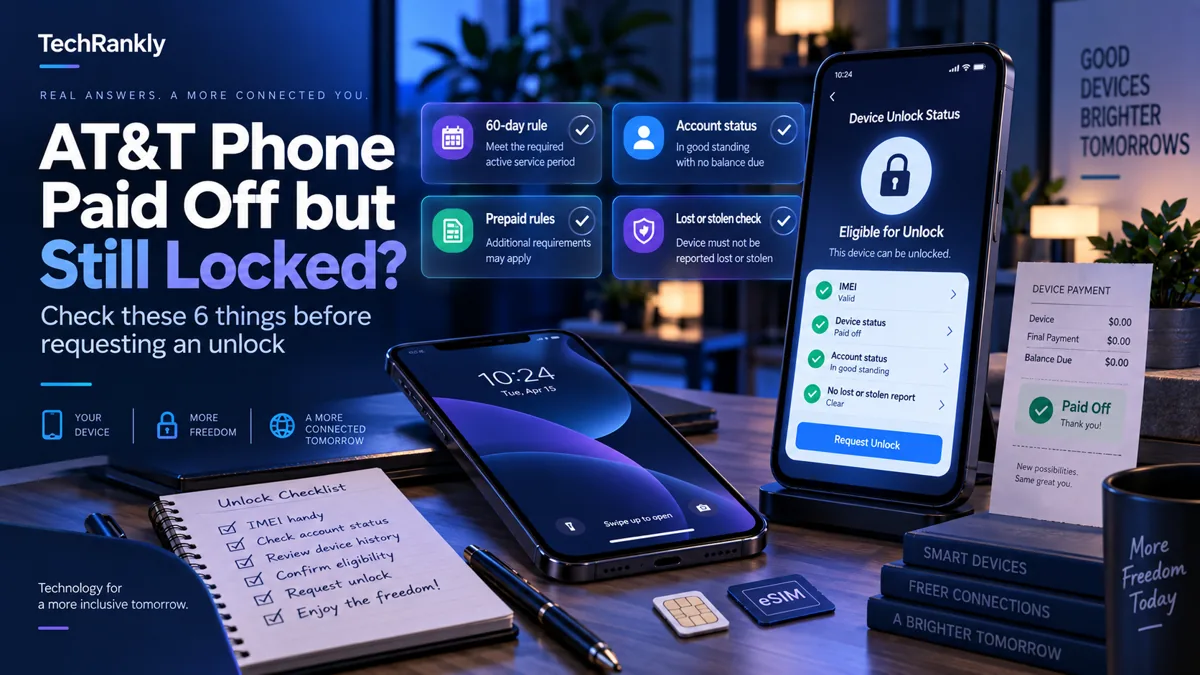
| Check | Current AT&T requirement |
|---|---|
| Purchase age | The device must generally have been purchased from AT&T more than 60 days ago. |
| Installment balance | The device must be paid in full before unlocking. |
| Other AT&T account | The device cannot be active on another AT&T account. |
| Lost/stolen/fraud status | The device must not be reported lost, stolen or involved in fraud. |
| Current customer account | The AT&T bill cannot be past due. |
| AT&T Prepaid | Prepaid phones currently require 12 months of service before they can be unlocked. |
1. Confirm the installment balance is actually zero
There is an important difference between planning to pay off a device and AT&T showing the installment balance as fully paid. AT&T’s unlock page says the installment balance must be zero before the device can be unlocked.
Sign in to the AT&T account associated with the phone and verify the device payment information. If the balance is not zero, resolve that first.
2. Check the 60-day purchase rule
AT&T currently says a device purchased from AT&T must have been purchased more than 60 days ago. A phone can therefore be fully paid and still fail another eligibility requirement if it is too new.
This is one reason “paid off” and “eligible to unlock” are not identical.
3. Make sure the phone is not active on another AT&T account
AT&T says the device cannot be active on another AT&T account. This matters especially with used phones.
If you bought an AT&T-branded device secondhand, paying the seller does not prove that the carrier account history is clean. Before assuming there is a technical fault, use the official unlock process and IMEI information to see whether AT&T accepts the device.
4. Check the current AT&T account balance
If you are an existing AT&T customer, AT&T says the account must be current and the bill cannot be past due.
A phone can therefore have a zero device installment balance while the wireless account itself has another overdue charge. Those are different balances.
5. Rule out a lost, stolen or fraud flag
AT&T will not unlock a device that has been reported lost, stolen or involved in fraud. If you purchased a used phone and the unlock request fails for this reason, do not try to bypass the carrier restriction with questionable software or paid “IMEI cleaning” services.
The appropriate next step is to resolve ownership and account history with the seller and AT&T.
6. Check whether special device rules apply
AT&T Prepaid
AT&T currently says prepaid phones require 12 months of service before they can be unlocked. It also distinguishes the process by device type: prepaid iPhones use an unlock request, while Android phones use the AT&T Device Unlock app.
Active-duty military deployment
AT&T publishes a deployment exception that can allow eligible active-duty customers to request an unlock before paying off the device, with supporting deployment documentation.
Business devices
AT&T says business-owned devices under contract can be unlocked after the service commitment has ended.
If you are no longer an AT&T customer
AT&T’s current unlock page says non-customers can still submit an unlock request for an AT&T device. You will need the device information, including the IMEI.
This is useful for legitimate secondhand purchases, but the device still has to satisfy AT&T’s unlock requirements.
How to find the IMEI without using an unknown website
Use the phone’s built-in settings or the manufacturer’s documented method to find the IMEI. Do not post the IMEI publicly in a forum or comment section.
The IMEI is an identifier for your device. Third-party “checker” sites are not necessary to submit AT&T’s official unlock request.
A simple decision tree
- Is the installment balance zero? If no, pay it off first.
- Was the AT&T device purchased more than 60 days ago? If no, the purchase-age rule may block the request.
- Is your AT&T account current? If no, resolve the overdue bill.
- Is the phone active on another AT&T account? If yes, that must be resolved.
- Was it reported lost, stolen or fraudulent? If yes, do not try to bypass the restriction.
- Is it prepaid, business-owned or tied to military deployment? Follow the special rule for that category.
- Do all checks pass? Submit the official unlock request.
What if all requirements appear to be met?
Use AT&T’s official unlock page rather than a third-party paid unlock service. If AT&T still rejects the request, note the exact rejection message and contact AT&T support with the account and device information requested through official channels.
A rejection message is more useful than repeatedly resubmitting without knowing which criterion failed.
Official AT&T unlock page
Check AT&T unlock requirements and submit a request →
TechRankly does not charge for unlock requests and does not provide a bypass. The carrier’s eligibility decision controls whether the device can be officially unlocked.
Common questions
Why is my phone still locked after I paid it off?
Because payment is only one requirement. The 60-day rule, account status, another AT&T account, lost/stolen status or a special prepaid/business rule can also matter.
Can I unlock an AT&T phone if I am no longer a customer?
AT&T currently provides an unlock-request path for non-customers, provided the device meets the eligibility requirements.
Can I unlock a prepaid AT&T phone immediately after buying it?
AT&T currently says prepaid phones require 12 months of service before unlocking.
Should I pay a website to “clean” an IMEI?
No. If the device has a lost, stolen or fraud issue, resolve the ownership or carrier issue through legitimate channels. A paid bypass can create additional risk and does not change the underlying ownership problem.