First confirm that coverage is the problem
A new wireless device is unlikely to solve an internet outage or an overloaded computer. Compare the normal desk location with a location near the primary router, and use Ethernet as a reference if possible. Our video-call troubleshooting guide gives a controlled sequence.
If both the near-router and desk connections perform poorly, investigate the upstream service and shared traffic first. If moving closer helps, a coverage or placement change is a more plausible investment.
| Option | Useful starting case | Main trade-off |
|---|---|---|
| Wired access point | Ethernet reaches the office or a nearby room | Requires a suitable wired path and configuration |
| Mesh system | Several areas need coordinated coverage | Wireless node placement and ecosystem compatibility matter |
| Range extender | A limited dead zone and modest requirements | Depends heavily on its upstream signal and operating mode |
| No new equipment | Router placement can be improved | May not overcome the building’s physical constraints |
Do not place the repeater inside the problem
A device using wireless backhaul needs a usable connection to the network upstream. Putting it at the farthest point with almost no signal may leave it repeating a weak connection. Test a position between the router and the office, following the manufacturer’s placement guidance.
Think about the two separate links: laptop to node, and node to router. Full signal bars for the first link do not prove the second link is good. An app may provide a connection-quality indicator, but the final check should be a representative call or transfer from the desk.
Use existing wiring when it fits the system
If Ethernet already reaches the office, a wired access point or compatible mesh node can reduce dependence on wireless backhaul. The correct topology varies by product and operating mode. For example, TP-Link’s Deco documentation distinguishes wiring rules for Router and Access Point modes.
A mesh system to compare when several rooms need coverage
Affiliate disclosure: As an Amazon Associate I earn from qualifying purchases. Some links below are affiliate links. See our affiliate disclosure.
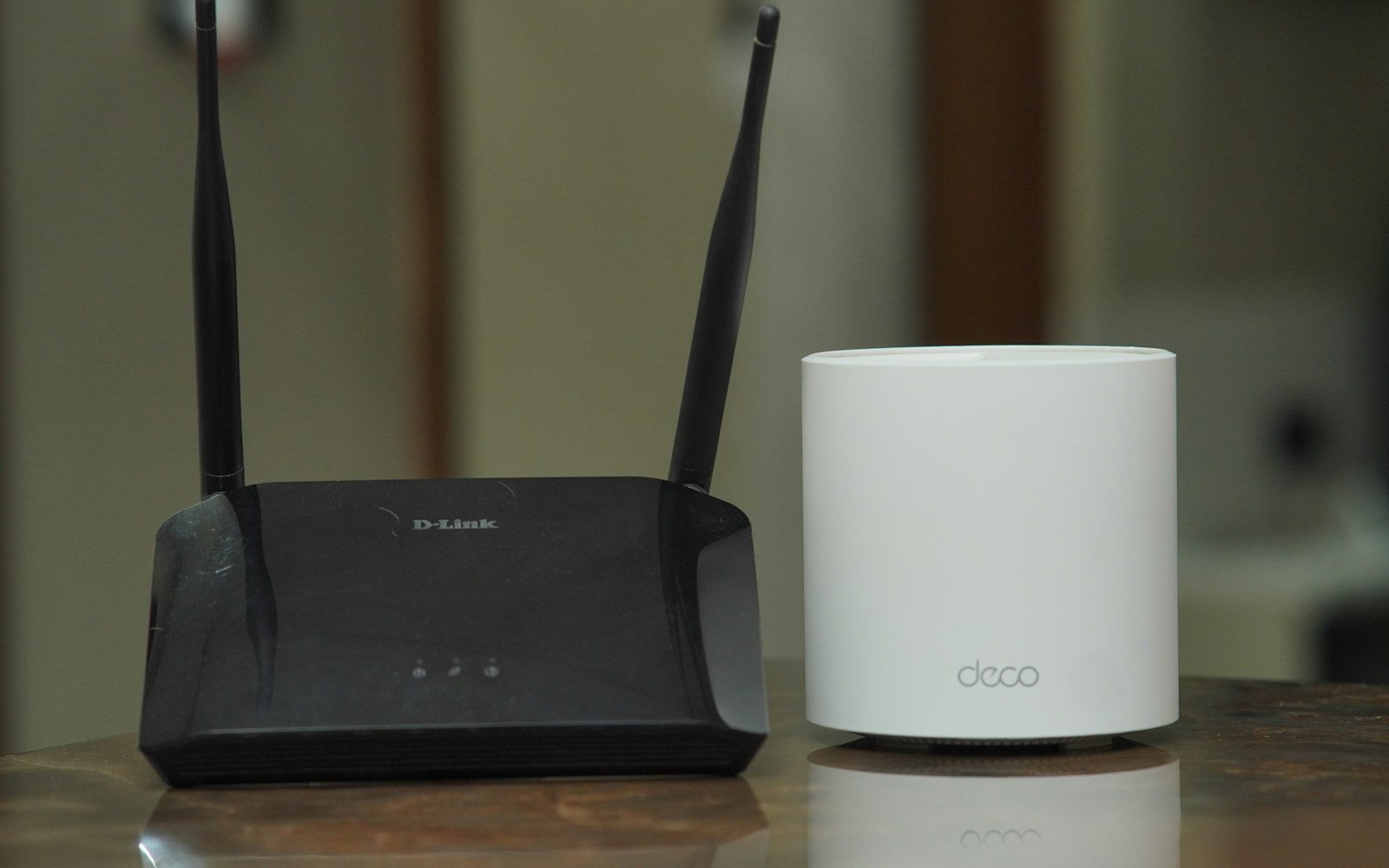
The TP-Link Deco X55 three-pack is one candidate when you need coordinated Wi-Fi coverage across several rooms and want the option of Ethernet backhaul. Check availability on Amazon. TP-Link lists Wi-Fi 6, three Gigabit Ethernet ports per unit, and optional Ethernet backhaul. It is more system than you need for one small dead zone, and placement still matters when the nodes use wireless backhaul.
That documentation is specific to Deco; do not apply its diagrams automatically to another brand. Check the manual for the exact system and confirm that your existing switches and cables are supported.
Compare the complete cost
Include the required number of nodes, power supplies, Ethernet adapters, and any installation work. Check whether features you need rely on a paid subscription. A low entry price is less useful if the necessary capability is unavailable without another purchase.
Also check firmware support, the return policy, and the ability to manage the system comfortably. More nodes are not automatically better. Place and test the minimum arrangement that solves the measured problem before expanding.
Buy for the room you use
For a fixed desk near existing wiring, start with the wired options. For several rooms and mobile devices, consider a coordinated mesh setup. For one modest dead zone, an extender may be enough if it has a good upstream connection and passes the workload test.
Avoid making the decision from advertised combined wireless speeds alone. Your computer’s support, the building, interference, and backhaul all affect the experience. See how Ethernet backhaul works before paying for a higher wireless specification.