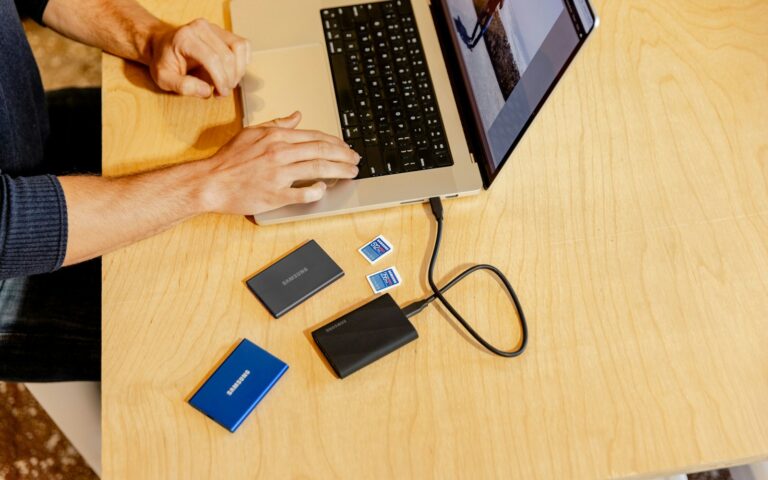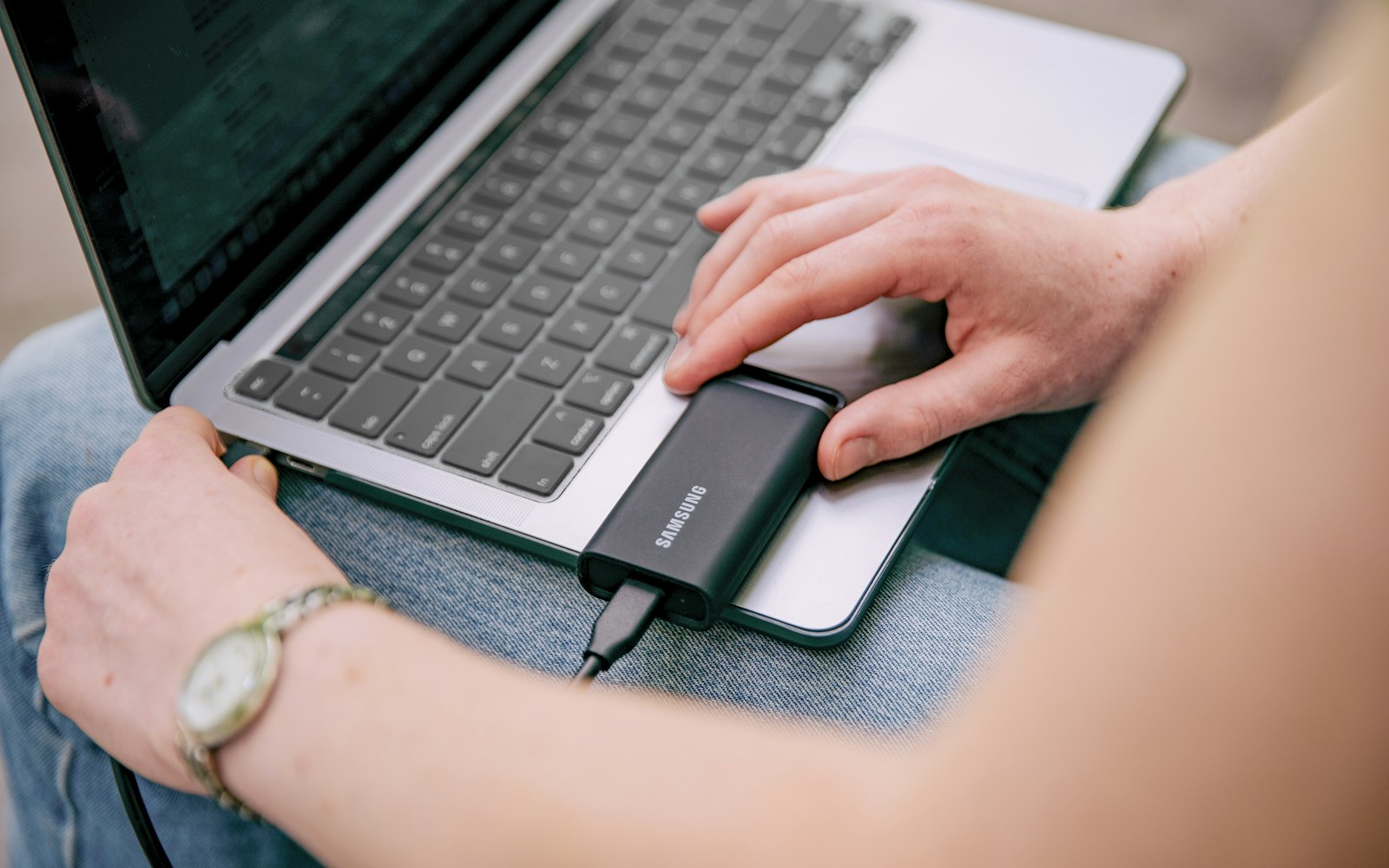
Use the capacity estimator
This calculator uses decimal gigabytes and terabytes: 1TB equals 1,000GB. The reserve is a planning choice, not a universal SSD requirement or a manufacturer performance recommendation. The calculator does not estimate backup-version retention, compression, or file-system overhead.
Formula: required capacity = (current files + monthly growth × months) ÷ (1 − reserve percentage ÷ 100). If the calculator does not load, you can apply the same formula manually.
Work through an example
Suppose you have 420GB of files and expect to add 25GB each month for a year. That produces 720GB of planned data. Dividing by 0.8 to allow a 20% reserve gives a nominal requirement of 900GB.
In this example, a marketed 1TB drive is close to the planned requirement, while a 2TB drive gives substantially more room. Whether that extra room is worth the price depends on how uncertain the growth estimate is and how inconvenient another upgrade would be. These are illustrative inputs, not estimates of a typical user’s storage needs.
Count the files your workflow creates
| Workflow | Frequently overlooked space |
|---|---|
| Photo editing | Originals, previews, catalogs, and exported copies |
| Video work | Source footage, proxies, caches, and multiple exports |
| Software projects | Dependencies, build artifacts, and local environments |
| Client archives | Revisions, delivered files, and supporting assets |
Measure a complete recent project instead of estimating from the final output. If your workload changes significantly from month to month, run the calculator with both a moderate and a high-growth scenario.
When 1TB is worth considering
A 1TB drive can make sense when measured files and expected growth fit comfortably, your projects are relatively predictable, and you already have a separate backup arrangement. It can also be appropriate as a transfer drive whose contents are moved elsewhere regularly.
Do not choose it purely because your laptop has a 1TB internal drive. The internal drive may be mostly empty, or your external project files may exceed it. Capacity labels on different devices are not a workload measurement.
When 2TB is easier to justify
Consider 2TB if you already approach 1TB of real data, expect substantial project growth, or regularly need multiple active projects on the drive. Compare the current cost for the same model and warranty conditions. Avoid downgrading the required connection or reliability criteria merely to maximize the capacity label.
Backup disks need separate planning. Apple’s Time Machine guidance recommends a backup device with at least twice the Mac’s storage capacity. That is application-specific guidance and should not be replaced by this working-storage calculator.
Capacity does not replace recovery
A larger drive still represents one physical device. Keep another recoverable copy of important work, and read sync versus backup to check the plan. Once capacity is clear, use the external SSD selection guide to compare interfaces and real compatibility.
Match a product to the calculated capacity
Affiliate disclosure: As an Amazon Associate I earn from qualifying purchases. Some links below are affiliate links. See our affiliate disclosure.
If your measured working files and reserve fit comfortably inside 1TB, the Samsung T7 1TB, Titan Gray (MU-PC1T0T/AM), is a model to compare. Check availability on Amazon. The linked version is 1TB. It is not the right selection if the estimator or backup application calls for more capacity; compare an appropriate larger drive instead.
For streaming, measure a representative recording and include the sessions you retain for editing. The $750 camera-and-storage plan and $1,000 combined production plan keep recording storage separate from the camera budget. A single SSD still needs a separate recovery arrangement.